 Passer au contenu



5 erreurs courantes que font les débutants en Handpan (et comment les éviter)
Summary
Nouveau dans le handpan ? Vous n’êtes pas seul—et beaucoup de débutants tombent dans les mêmes pièges. De l’utilisation de mauvaises techniques à l’achat du mauvais instrument, voici un aperçu des 5 erreurs courantes avec le handpan et comment les éviter comme un pro.
Des mauvaises habitudes d’entretien à l’utilisation d’une technique de jeu inappropriée (oui, certains débutants jouent avec le bout des doigts !), en passant par les pièges à l’achat, ce guide offre des conseils pratiques pour éviter la frustration initiale et poser une base solide pour votre parcours musical.
Le handpan est l’un des instruments les plus envoûtants qui soient—il sonne comme un rêve et crée une connexion profonde entre le joueur et l’auditeur. Mais voici le hic : aussi fascinant soit-il, les débutants commettent souvent quelques erreurs qui peuvent ralentir leur progression ou même endommager l’instrument.
Examinons les 5 erreurs les plus courantes chez les débutants en handpan, et bien sûr, comment les éviter !
1. Acheter le mauvais handpan (nous sommes tous passés par là)
Une autre erreur fréquente : acheter un handpan qui ne vous convient tout simplement pas. Malheureusement, beaucoup de débutants se précipitent sur des offres bon marché ou tombent dans des arnaques. Notre article précédent expliquait comment choisir un handpan professionnel. 6 conseils essentiels pour acheter un handpan. Comment choisir les gammes et les matériaux
Erreurs courantes lors de l'achat :
-
Acheter sur Amazon ou auprès de vendeurs inconnus
-
Choisir une gamme qui ne correspond pas à leur goût musical
-
Choisir des pans de faible qualité, produits en masse avec un mauvais accord
Comment l'éviter :
-
Faites vos recherches. Optez pour des fabricants réputés avec de bonnes critiques et des échantillons sonores.
-
Comprenez la gamme et l'accord—souhaitez-vous quelque chose de joyeux et entraînant (comme D Kurd) ou quelque chose de méditatif et profond (comme le mineur celtique) ?
Aussi, ne vous précipitez pas. Trouver le bon handpan, c’est un peu comme choisir un partenaire de vie—ça vaut la peine d’attendre.
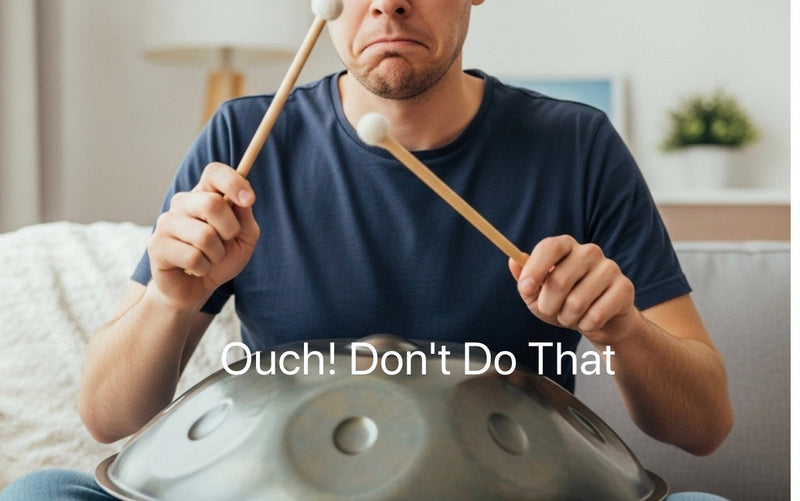
2. Jouer avec le bout des doigts (Aïe ! Ne faites pas ça)
Si vous tapez sur votre handpan avec vos boutons de doigts—arrêtez tout de suite. Cela peut sembler intuitif au début, mais c’est l’une des pires habitudes à prendre.
Pourquoi c’est un problème :
-
Le handpan n’a pas été conçu pour être joué avec des tapotements nets du bout des doigts.
-
Vous risquez de produire des sons durs et métalliques.
-
Avec le temps, cela pourrait fatiguer vos doigts et abîmer la surface.
Que faire à la place :
Utilisez les coussins de vos doigts, pas les bouts. Visez des tapotements doux et contrôlés qui laissent les notes s’épanouir. Laissez votre main rebondir légèrement—c’est plus un mouvement de toucher-relâcher qu’un coup sec.
Et honnêtement, l’une des meilleures choses que vous puissiez faire est d’investir dans un cours structuré de handpan. Vous apprendrez la bonne posture, les techniques des doigts, les motifs rythmiques, et même des exercices de respiration pour approfondir votre connexion avec l’instrument.
3. Se lancer sans aucune leçon
Écoutez, je comprends—les handpans sont très intuitifs, et une partie de leur charme est qu’ils ne nécessitent pas des années de théorie musicale pour en profiter. Mais se lancer sans aucune guidance ? C’est comme essayer de danser la salsa après avoir regardé un TikTok de 10 secondes.
Ce qui arrive sans formation :
-
Vous pourriez prendre de mauvaises habitudes difficiles à défaire.
-
Vous aurez probablement du mal à développer le rythme et la régularité.
-
Vos progrès seront lents et frustrants.
Que faire :
Essayez un cours en ligne ou trouvez un atelier local. Même quelques heures avec un professeur de handpan expérimenté peuvent faire décoller vos progrès. Vous apprendrez aussi la disposition des notes, les gammes, et comment créer un flux émotionnel dans votre musique.
4. Trop jouer et ne pas écouter
Les débutants cherchent souvent à jouer plus vite ou à impressionner les autres. Mais la magie du handpan réside dans le écoute—de soi, des notes, et de l’espace entre elles.
L’erreur :
-
Frapper constamment les notes sans rythme ni fluidité
-
Se concentrer trop sur la technique et pas assez sur le ressenti
-
Ne pas laisser de silence ou de « respiration » dans la musique
Ce qu’il faut essayer à la place :
-
Jouez lentement. Laissez chaque note résonner et vibrer.
-
Enregistrez-vous et réécoutez-vous.
-
Pratiquez des motifs « appel et réponse », ou imitez les sons et rythmes de la nature.
Le handpan est un instrument méditatif—moins c’est souvent plus.
5. Négliger l’entretien du handpan
Commençons par les bases. Les handpans peuvent sembler robustes, mais ce sont des instruments sensibles qui demandent un peu de soin.
Erreurs courantes d’entretien :
-
Ne pas essuyer le handpan après avoir joué (bonjour, la rouille !)
-
Le laisser dans des environnements humides ou extrêmement secs
-
Utiliser le mauvais type d’huile ou ne pas l’huiler du tout
-
Le ranger sans housse de protection
Comment le réparer :
-
Après chaque séance, essuyez doucement votre handpan avec un chiffon en microfibre.
-
Rangez-le dans un endroit frais et sec, idéalement dans sa housse.
-
Appliquez une huile légère et non corrosive toutes les quelques semaines.
Croyez-moi—montrez un peu d’amour à votre handpan, et il vous récompensera par des années de sons magnifiques. Notre marque (Pures Music) de handpans professionnels peut garder l’accord pendant de nombreuses années.
Terminons (Ou devrions-nous dire... Laissons-le résonner)
Commencer avec le handpan est une expérience magique, mais il est facile de faire des erreurs qui peuvent freiner votre progression ou votre plaisir. Voici un bref résumé de ce que nous avons vu :
-
Prenez soin de votre handpan—ce n’est pas qu’un instrument, c’est un investissement.
-
Utilisez la bonne technique (pas de piqûres du bout des doigts !).
-
Prenez le temps d’apprendre—les cours et les enseignants sont vos meilleurs alliés.
-
Ne précipitez pas le processus. Laissez la musique s’écouler naturellement.
En évitant ces erreurs courantes chez les débutants, vous protégerez non seulement votre instrument, mais vous débloquerez aussi un tout nouveau niveau de son, de fluidité et de créativité.